
Impact of sustained unemployment on consumer behavior
The everyday understanding of the term unemployment is ‘joblessness’ – which is understood as being without a formal paying job, but wanting it. Unemployment is one of those economic factors that has been studied and examined for many years. It is one of the most important economic indicators that governments and economists follow very closely. It is important to understand the definition of unemployment as well as the reasons that unemployment exists.
Unemployed (official definition): Persons aged 15–65 who do not have a job or business; they are capable of working or starting a business but have not done so. In addition, they need to have actively looked for work or tried to start a business at some point in the four weeks preceding the census survey. The people who are out of the labour market or who are not economically active are those in the age category 15 to 65 years who are not available for work. Unemployment rate on the other hand is then the number of unemployed persons expressed as a percentage of the labour force. Not only are people considered to be unemployed based on the above definition, there are people who are discouraged job seekers; a person is considered to be a discouraged job-seeker if they wanted to work but there are no jobs in the area; they were unable to find work that required their skills, or they have lost hope of finding any kind of work.
Unemployment has a negative impact on the unemployed individual as well as on businesses, government and society as a whole. Economists can make a distinction between the economic costs arising from people out of work and the social costs that often result. Some of the economic costs of unemployment are loss of production and output of goods and services, loss of investment in human capital, fiscal costs to the government as well as business pressures. Social costs of unemployment include increased rates of poverty and income inequality, family and societal pressures as well as community fears and pressures.
Now taking a look at the stats below taken from TRADINGECONOMICS | SOUTH AFRICAN RESERVE BANK from 2018 – 2021.
Impact of sustained unemployment on consumer behavior
Impact of sustained unemployment on consumer behavior
Impact of sustained unemployment on consumer behavior
Impact of sustained unemployment on consumer behavior
Impact of sustained unemployment on consumer behavior
Impact of sustained unemployment on consumer behavior
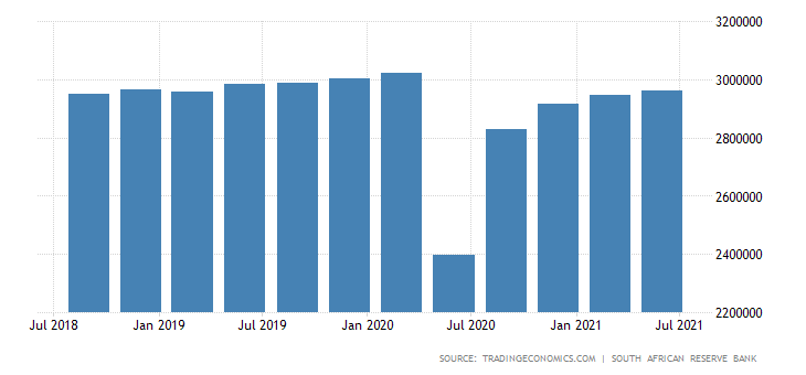
We can see how consumer spending took a huge knock in July 2020 and this was as a result of the global pandemic that resulted in many businesses closing down and people been unemployed. During the second quarter of 2020, the impact of the corona virus pandemic on the wallets of South African consumers became noticeable: during those months, total consumer spending in South Africa amounted to about 1.66 trillion South African Rand, which is a decrease of about 15 percent compared to the first months of 2020. By the first quarter of 2021, the country's spending numbers had recuperated, standing at a quarterly total of 1.94 trillion South African Rand.
When unemployment is high, it means that the number of people looking for jobs is significantly higher than the number of jobs available. Low levels of unemployment correspond with higher inflation, while high unemployment corresponds with lower inflation and even deflation. From a logical standpoint, this relationship makes sense. When unemployment is low, more consumers have unrestricted income to purchase goods. Demand for goods rises, and when demand rises, prices follow. During periods of high unemployment, consumers generally purchase fewer goods, which puts downward pressure on prices and reduces inflation.
Income is one of the many factors that affect consumer behaviour because it has the ability to influence the buying behaviour of an individual. When a consumer has a higher disposable income, it gives more opportunity for the consumer to spend not just on necessities but on luxury products as well. Other areas that affect consumer spending and behaviour is savings, liquid assets and consumer credit.